
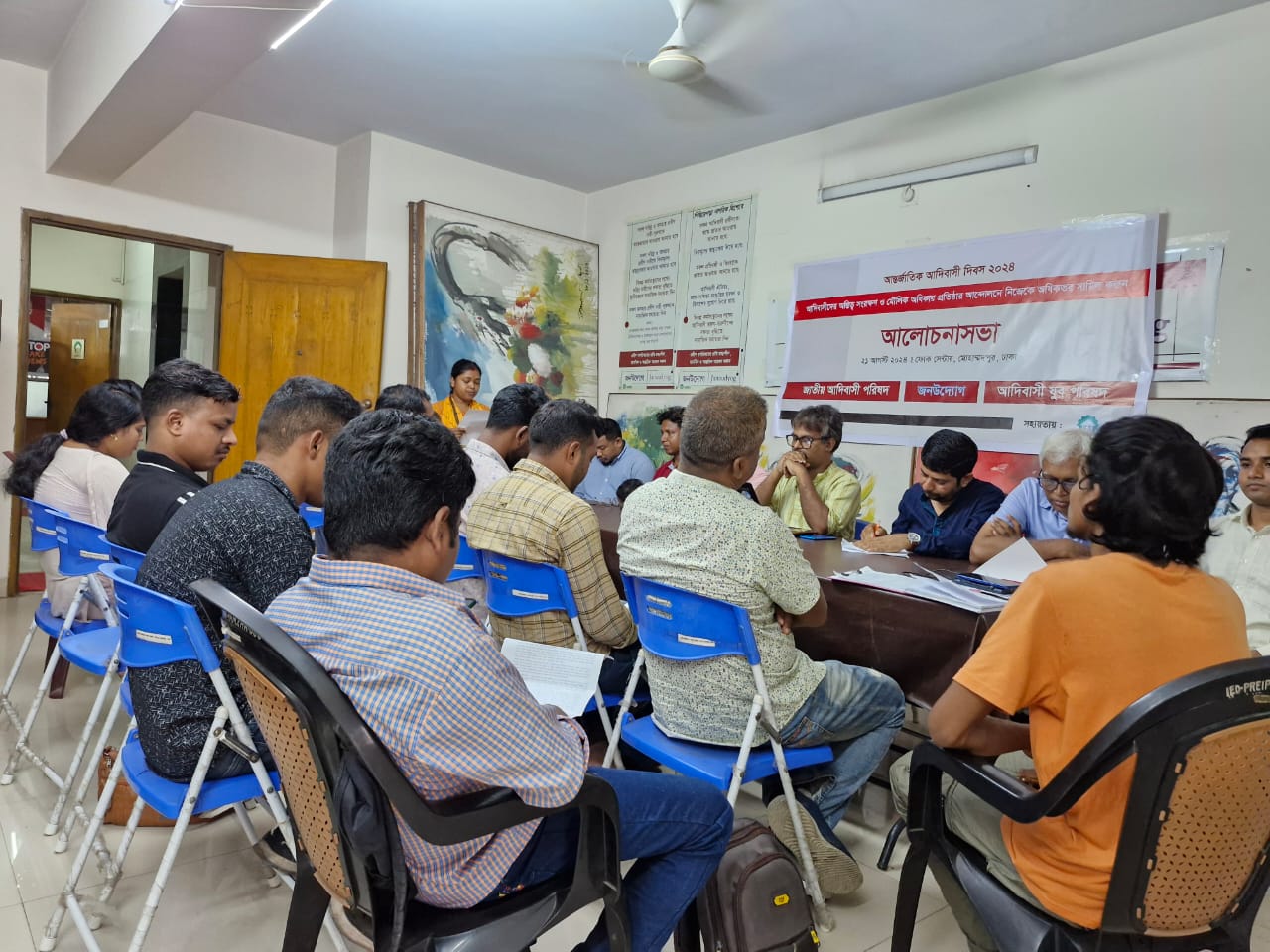
A discussion meeting was held in Dhaka on the occasion of International Adivasi Day, jointly organized by the National Adivasi Parishad, Adivasi Youth Council, and Jan Udyog. This year's Adivasi Day theme was, "Involve Yourself More in the Movement to Preserve the Existence of Adivasi and Establish Basic Rights."
Nirla Mardi, Cultural Secretary of the Central Committee of the National Adivasi Parishad, presented the concept paper at the meeting, which took place at the Folk Center in Mohammadpur on Wednesday (August 21). The event was moderated by Vibhutibhushan Mahato and chaired by Harendranath Singh, President of the Greater Dhaka Committee of the National Adivasi Parishad.
Addressing the recent anti-discrimination movement, writer and researcher Pavel Parth stated, “The leaders have driven this movement with specific demands, consistently challenging authoritarian regimes. A significant number of women have taken to the streets to propel this movement forward. When Kumudini Hajong was arrested by the British police in Susong Durgapur, Rashimani Hajong led a formal coup with 10-15 people. Authoritarianism is only confronted when more women participate in movements like Tevaga, the Hul, or the Santal Rebellion.”
Parth emphasized, "State reforms must be reflected in the constitution and judicial system. Words like ‘small ethnic group’ should be replaced with ‘tribal’ in the constitution. This movement also echoes Maulana Bhasani’s speech, reminding us that the religiousization of the state is not feasible."
He further highlighted a misconception among students, noting, "The term 'Aboriginal' has often been confused with 'Adivasi.' This needs to be clarified in discussions."
Subodh M Baske, former president of the Santal Students Union, urged unity among all tribal communities living in hills, plains, and tea plantations. “Everyone must be vocal. No movement succeeds without multidimensional participation,” he remarked.
Bishuram Murmu, General Secretary of the Thakurgaon District of the National Adivasi Parishad, asserted, "Remaining silent will not fulfill our rights. It is time to speak out. Some have questioned recent cultural displays, but cultural activities can also serve as a language of protest."
He reiterated the need for unity among tribals, saying, "In the current context, tribal students and youth should present a roadmap to the interim government through national dialogue or on the streets. This roadmap can serve as our liberation certificate."
Tony Mathew Chiran, Vice President of the Bangladesh Adivasi Youth Forum, pointed out the significant role social media has played in recent movements. "Some will make sarcastic comments, but we must speak for ourselves. We must continuously voice our demands online," he said.
Varun Munda, a member of a tea worker's family, shared his perspective, saying, "Sylhet's tea industry thrives, with various ethnic groups living there. Adivasis primarily work as laborers in tea plantations, earning 170 taka for 8 hours a day, along with a small weekly ration. Tribal organizations should advocate for the labor rights of tea workers. In response to agitation in 2020, the government promised us housing. Adivasi widows and the disabled should be provided with allowances."
Manvendra Deb, farmer leader and former president of the Bangladesh Students' Union, stated, "There can be no demands or preservation of our existence without struggle. We must continue the fight by highlighting the contributions of martyrs like Lyton Hembrum."
Pallab Chakma, Executive Director of the Kapeng Foundation, remarked, "The culture of fear has ended. Recently, in Rangamati, tribals have participated in large protests. There are many misconceptions about the hills and tribals in society, which is disheartening. The more we unite across hills and plains, the stronger our demands will be. If others speak on our behalf, our claims will be distorted. The word 'Adivasi' must be loudly and proudly asserted."
Adivasi youth and student representatives from various parts of the country actively participated in the meeting.