
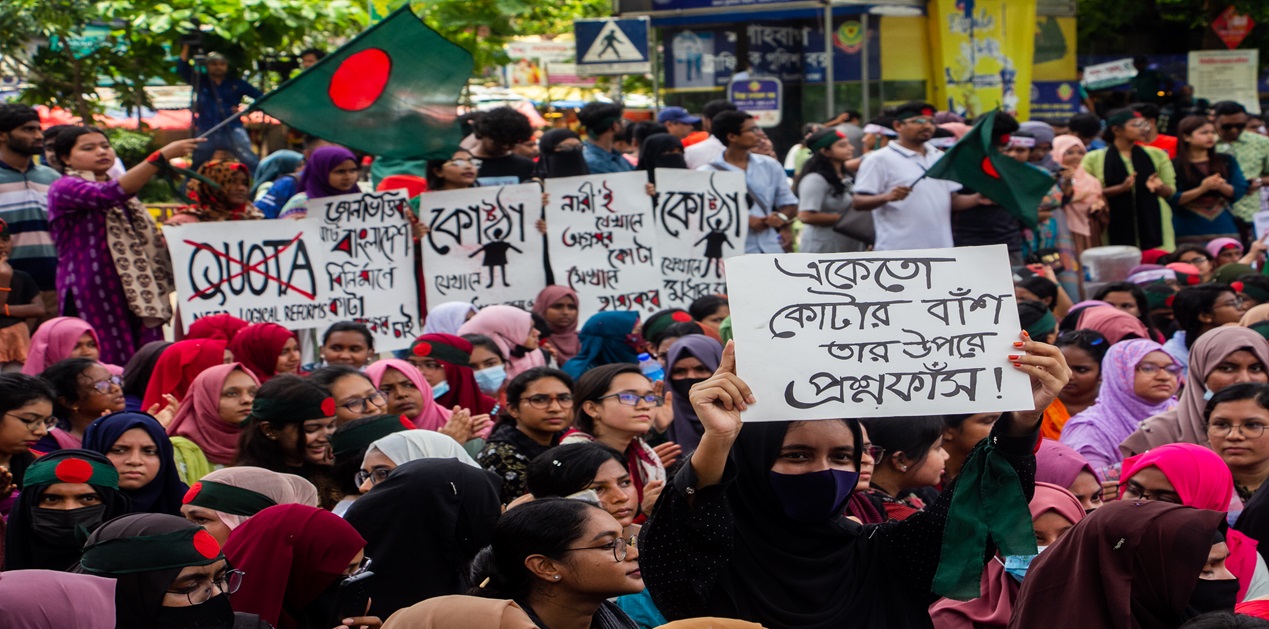
Less than a year ago, the streets of Dhaka were burning with the slogans of young people demanding a merit-based society. The so-called “July Uprising” roared with calls to abolish all quotas — not only for freedom fighters' descendants but also for women, Adivasis, and disabled persons. That movement was loud, aggressive, and highly moralistic in its tone. It declared itself the voice of justice and fairness, aiming to build a Bangladesh beyond patronage politics and inherited privilege. But now, just ten months later, the same leaders who demanded the abolition of all quotas have shamelessly turned around and institutionalized a new system of quota — this time for themselves.
This betrayal of ideals is not just hypocrisy; it is state capture by a new elite hiding behind the rhetoric of revolution. At the heart of this betrayal sits Dr. Muhammad Yunus, the unelected Chief Adviser cum de facto Prime Minister of the interim government, who has now given his blessing to the full-scale monetization and glorification of the so-called “July martyrs” and “July fighters.”
Let’s be clear: no democracy, no republic can survive when a protest movement becomes a ticket to lifetime privilege. But that’s exactly what’s happening. Under the Yunus regime — supported by cabinet members like Nahid Islam, Asif Mahmud Sajib Bhuiyan, and Mahfuz Alam — the state has rolled out a sweeping and permanent system of privileges for the participants of the July Uprising. These include one-time cash handouts of up to 30 lakh taka per family, monthly allowances of 20,000 taka, priority access to jobs, educational quotas, housing, and even medical treatment at home and abroad. They have gone as far as creating a brand-new government department — the “July Mass Uprising Directorate” — to institutionalize these benefits and enshrine their version of “history” in the national consciousness.
From Uprising to Entitlement: The Birth of a New Ruling Class
Let’s not forget: just ten months ago, these were the same people who violently opposed any form of affirmative action — even for the most marginalized. When women demanded gender quotas in public service, they were scoffed at and told to “compete equally.” When Adivasis raised longstanding concerns about systemic exclusion, their voices were dismissed as fringe complaints. When people with disabilities asked for basic accommodations, they were ridiculed for wanting “special treatment.” And of course, when it came to defending the quota for freedom fighters — even in its symbolic form — it was immediately framed as corruption, nepotism, and rent-seeking. So what changed?
The answer is brutally simple: power. We are witnessing the all-too-familiar metamorphosis of radical populists into self-serving oligarchs. After the July uprising dismantled the Sheikh Hasina government, its most visible leaders — Nahid, Asif, Mahfuz, and others — wasted no time in abandoning their egalitarian slogans. The rhetoric of “justice” and “merit” was replaced overnight with a politics of patronage and privilege. What has emerged in the name of reform is not a fairer society, but a more cynical one. The new quota regime is larger, more arbitrary, and ultimately more self-serving than anything it replaced. It isn’t about righting historical wrongs — it’s about entrenching a new ruling class under the guise of revolutionary legitimacy.
Nowhere is this more blatant than in the decision by Dhaka University to offer special admission privileges to the families of “July martyrs.” Universities should stand as sanctuaries of merit, debate, and intellectual integrity. Instead, they have become tools of political appeasement. Under pressure from the Yunus-backed interim government, DU has institutionalized nepotism — not as a flaw, but as a feature. This isn’t education reform; it’s political bribery wrapped in the language of sacrifice.
The Quota They Once Hated: Institutionalizing Hypocrisy
The July movement, once hailed as a youth-led call for change, has now morphed into a corrupt welfare program for its inner circle. It rewards not need, but loyalty. The categorization of “injured July fighters” into three levels — with financial benefits accordingly — reeks of bureaucratic farce. How do you quantify sacrifice in decimal points and convert it into a budget line? This system invites fraud, inflation of injury, and endless litigation.
The Yunus regime has also set a dangerous precedent by allocating national savings certificates, training funds, and rehabilitation schemes to these so-called fighters. These are public resources — funded by ordinary taxpayers — being redirected to reward political actors who played a role in regime change. Where is the justice in that?
And the worst part? There is virtually no accountability or transparency in this entire process. The lists of martyrs and injured are published in gazettes with zero independent verification. The Ministry of Liberation War Affairs, now tasked with administering the July quota, has no history of impartiality. Anyone who raises questions is accused of “disrespecting the dead” or “siding with the old regime.”
This Orwellian reversal — from “abolish all quotas” to “give us all the quotas” — is the defining characteristic of the Yunus government. It claims to be a government of transition, but in truth, it is one of consolidation. It consolidates the spoils of an uprising into personal and class privilege. It rewrites history through official documents and press releases. And it silences criticism by weaponizing state emotion — the language of martyrdom and sacrifice.
Even more alarmingly, this regime has normalized the idea that state benefits can be awarded for political participation. This opens the door to a permanent politicization of social policy. What happens when the next group takes to the streets and demands similar privileges? What happens to the legitimacy of public service when entry is based not on skill or merit, but on affiliation with a particular protest?
A Regime Without a Mandate, A System Without Justice
Yunus, Nahid, Asif, and Mahfuz are not reformers — they are opportunists. These men did not rise from the people; they rose over the people. They hijacked a spontaneous student movement, repackaged it as a revolutionary force, and used its moral momentum to dislodge an elected government. But once in power, they abandoned the ideals they once shouted in the streets. Today, they preside over a government that rewards loyalty, not merit; obedience, not justice.
This is not reform. It is the consolidation of a new elite, hiding behind the blood-stained banners of the July Uprising. They speak in the language of sacrifice, but they practice the politics of entitlement — ensuring lifetime benefits for their inner circle while the rest of the country struggles with inflation, joblessness, and institutional decay.
It is long past time to stop romanticizing the July Uprising. We must begin asking hard, uncomfortable questions: Who really benefited from this so-called revolution? Who decided which protester was a martyr and which wasn’t? What processes exist to verify these claims? How much taxpayer money is being funneled into the July benefits programs? And at what cost to other critical sectors — education, health, rural development?
Most importantly: What gives this interim regime — which holds no electoral mandate and enjoys no constitutional legitimacy — the right to enact permanent laws, build new state institutions, and re-engineer national policy in its image? This is not transitional governance. It is political colonization by technocrats and elites.
Bangladesh does not need another class of state-sponsored beneficiaries. It does not need performative revolutions that turn into pipelines of privilege. What this country needs is fairness, transparency, and accountability. It needs a government that practices what it preaches — not one that weaponizes martyrdom to silence dissent.
Let history remember this moment for what it truly is — not a people’s revolution, but a rebranding of power. Not a new dawn, but an old system wearing new clothes.
Power must return to the people — not be hoarded by those who claimed to speak for them.
References:
Dhaka Tribune. (2025, May 27). DU offers 'special admission facilities' for families of July uprising victims. https://www.dhakatribune.com/bangladesh/382272/du-offers-special-admission-facilities-for
Dhaka Tribune. (2025, February 27). CA press wing: Monthly allowance for July victims likely from March. https://www.dhakatribune.com/bangladesh/government-affairs/374987/ca-press-wing-monthly-allowance-for-july-victims
The Daily Star. (2025, March 3). July victims’ families to share quota with freedom fighters’ children. https://www.thedailystar.net/news/bangladesh/education/news/july-victims-families-share-quota-freedom-fighters-children-3837886
The Daily Ittefaq. (2025, May 17). Families of July coup victims and martyrs will receive loans on easy terms. https://www.ittefaq.com.bd/732280