
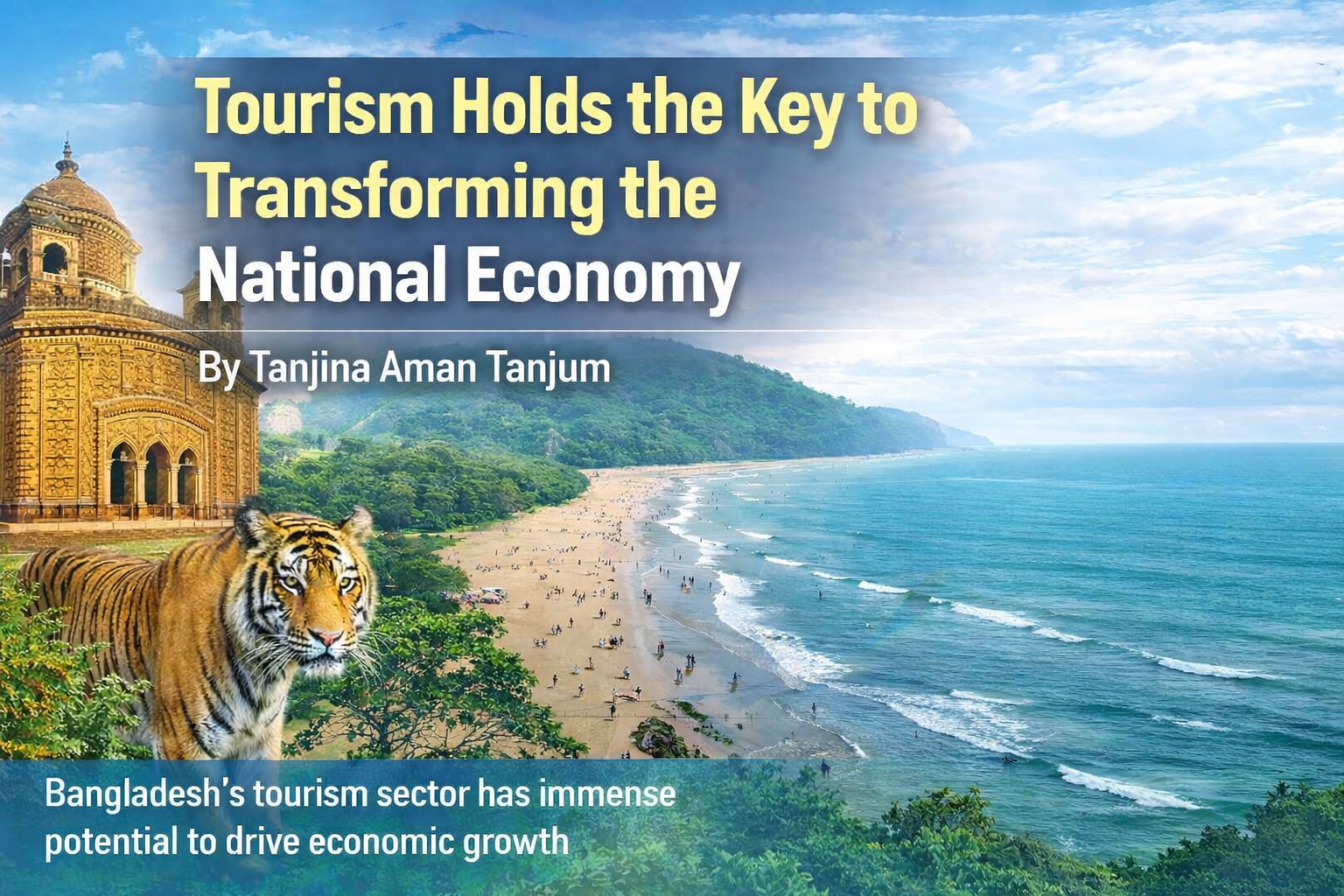
By Tanjina Aman Tanjum || Bangladesh possesses immense potential in the tourism sector. Its diverse array of attractions is capable of captivating visitors from all walks of life. Alongside major initiatives, it is essential to undertake a series of smaller, incremental steps. These modest yet significant initiatives have the power to revolutionize Bangladesh's tourism landscape. The world is well aware that Bangladesh is home to both Cox's Bazar-the world's longest natural sea beach-and the Sundarbans, the largest mangrove forest and the habitat of the world-renowned Royal Bengal Tiger. Furthermore, archaeological treasures-such as Kantajew Temple and Paharpur-are scattered across the country, alongside various religious structures including mosques, temples, and pagodas. With its wealth of waterways, rocky landscapes, forests, antiquities, indigenous cultures, and tea gardens, Bangladesh offers a rich and diverse range of tourist destinations. Through its vibrant and diverse culture, the country is capable of attracting both domestic and international tourists. Tourism is often described as an "invisible economic force." It ranks among the world's leading revenue-generating sectors. For many developing nations, the tourism industry serves as the very "lifeblood" of the economy, evolving into the primary driving force behind their economic growth and social development. Numerous other industries-whether directly or indirectly-are dependent upon this sector. Tourism is a multifaceted and labor-intensive industry. It has gained global recognition as one of the fastest-expanding and largest commercial activities in existence. The tourism sector generates a vast number of employment opportunities. Through the various sectors linked to the tourism industry-such as transportation, hotels, motels, restaurants, resorts, airlines, and communication services-many countries around the world generate substantial annual revenue, often exceeding the earnings derived from any other major industry. Bangladesh, too, possesses immense potential in this regard; its geographical location and natural environment are exceptionally favorable for the growth of its tourism industry. A distinct and specialized plan must be formulated for the Chittagong region. Nowhere else in the world can one find a single location that offers such a comprehensive package of attractions-encompassing hills, sea beaches, rivers, rocky terrains, forests, historical and heritage architecture, and various religious sites-all within one area. Consequently, the Chittagong region requires special emphasis within the tourism sector, accompanied by a corresponding increase in budgetary allocation. The Sundarbans represents another highly compelling attraction; however, different sections of the forest are currently managed and administered by various distinct government departments. This fragmentation of authority often results in a sluggish pace of development within the region. Consequently, a dedicated department or agency could be established for the Sundarbans. If a separate department were created, the overall control of the Sundarbans would be consolidated under a single authority. As a result, the processes of decision-making and implementation would become easier and could be accomplished within a shorter timeframe. In the neighboring Indian state of West Bengal, there is already a distinct department-complete with a dedicated minister-specifically for the Sundarbans. Yet, despite the fact that 62 percent of the Sundarbans lies within Bangladesh, no such separate department currently exists here. The potential of ecotourism must be harnessed to its fullest extent. Significant progress has already been made in this regard; with the assistance of local administrations, numerous small tourism spots have sprung up across various parts of Bangladesh. However, plans could be formulated and implemented to systematically develop the larger tourism hubs, transforming them into even more tourist-friendly destinations. The greater the influx of foreign tourists to a country, the higher its revenue from tourism. Countries such as the United States, France, and those across Europe experience a particularly high volume of foreign visitors; consequently, their earnings from the tourism sector are substantial. Within Asia, the primary reason for the high tourism revenue generated by nations like China and Thailand is, in fact, the presence of foreign tourists. In our own region, countries like India and Sri Lanka generate significant tourism revenue-a success largely attributable to their strategic planning and foresight. Smaller nations-such as Hong Kong, Singapore, Macau, the Maldives, and Fiji-derive immense revenue from their tourism sectors, driven almost exclusively by the arrival of foreign visitors. China, Japan, and Malaysia also generate substantial tourism revenue, relying more heavily on foreign tourists than on domestic ones. Notably, Chinese tourists play a pivotal role in boosting tourism earnings across all the aforementioned nations. To promote the tourism industry, images depicting the tourist attractions or cultural heritage of a specific region could be printed on passenger tickets for trains, buses, steamers, and launches. Tickets issued at relevant train stations should feature images of local tourist sites, accompanied by concise captions. This subtle approach would allow passengers to subconsciously learn about the significant landmarks and heritage of the region they are visiting. Even if implementing this on a district-by-district basis proves unfeasible, a region-based approach could certainly be adopted for railway tickets. However, for bus and water transport tickets, priority should be given to showcasing the specific locality being served. Another highly effective recommendation would be to display visual imagery of local tourist destinations on the walls of train stations, bus terminals, and river ports; furthermore, screening promotional videos would be an excellent initiative. I believe this would inspire passengers waiting for their trains to venture out and explore nearby tourist spots. Globally, Chinese tourists are known to be high spenders. Since the majority of Chinese citizens are adherents of Buddhism, it is essential to enhance connectivity and improve facilities at Buddhist heritage sites in order to attract them. Successfully attracting Chinese tourists would undoubtedly inject fresh momentum into the national economy. Thailand and Malaysia are significantly advanced in their tourism sectors; indeed, these two nations consistently record a very high volume of Chinese tourist arrivals. India also generates substantial revenue from tourism; however, it has not yet managed to match the volume of Chinese and Japanese tourists attracted by the two aforementioned nations. Consequently, India currently lags behind those two countries in this regard. A significant portion of global tourists belongs to the Christian faith. Many travelers enjoy visiting renowned religious sites associated with various faiths. Therefore, I believe it is essential to place greater emphasis on religious heritage and monuments. Special attention-including improvements in transportation and connectivity—must also be directed toward the cultural sites of indigenous ethnic groups. School textbooks could incorporate more written content and imagery featuring various tourist destinations. The educational systems of many developed nations place significant emphasis on travel and exploration. This allows students to gain firsthand knowledge of diverse cultures-both domestic and international—and equips them to better navigate various challenges later in life. Arrangements should be made to distribute promotional leaflets, magazines, or books containing relevant information to various foreign embassies; this would serve to attract foreign visitors and expatriates. India, for instance, has adopted various strategies to promote its tourist destinations, including the launch of numerous dedicated websites. These online platforms are highly informative-a prime example being the site "Incredible India," which is rich in videos, photographs, and comprehensive information. Much like India, we too could launch similar websites; furthermore, we could enrich the content of our existing tourism portals. Many foreign tourists often prefer an open and unrestricted environment-a preference rooted in their own cultural norms. Consequently, it may be necessary to designate reserved zones for foreign visitors in popular coastal areas such as Cox's Bazar and Kuakata. By enabling foreign tourists to move about freely and comfortably-away from the crowds of local visitors-we can significantly enhance our ability to attract them. Above all, it is imperative to improve both transportation infrastructure and security measures at all tourist destinations. We must also cultivate a pool of skilled and professionally trained tour guides-individuals who are proficient in English (in addition to Bengali), possess strong interpersonal skills, and can effectively earn the trust and confidence of foreign visitors. To achieve this, comprehensive training programs must be implemented to ensure that guides-particularly those catering to English speakers and speakers of other foreign languages-are highly competent. However, it is equally crucial to curb the menace of touts and middlemen, whose predatory activities frequently leave foreign tourists feeling frustrated and dissatisfied. We must identify and take action against those—including rickshaw pullers, boatmen, and drivers of cars and microbuses—who engage in profiteering at the expense of visitors. Such incidents can, at times, be deeply distressing for tourists. As a potential solution, we could consider establishing designated zones exclusively for foreign visitors. Provisions for accommodation and entertainment facilities must be established there. It is imperative to improve the transportation infrastructure serving these tourist destinations. Issues such as a lack of security, theft or mugging, and unhygienic conditions on roads or at tourist sites are matters of concern for foreign visitors. In many locations, the transportation network remains inadequate. Foreigners generally prefer traveling by train, as it offers a comfortable experience. By enhancing these services, we not only ensure that foreign visitors feel at ease but also encourage them to spend substantial amounts—a scenario from which we stand to benefit significantly. In India, for instance, I have observed that there is a separate ticketing system specifically for foreign nationals; we could implement a similar arrangement here. Rail facilities must be further upgraded to ensure the comfort of international tourists. Under the current administration, the railway sector has witnessed substantial development, including the extension of the rail line all the way to Cox's Bazar. Rail connectivity should now be extended to those tourist regions that currently lack railway access. The country's current 17 GI (Geographical Indication) products must be promoted among both domestic and international tourists. Additionally, a selection of renowned local food items and products could be included in this initiative. The connecting roads leading to many tourist destinations are currently narrow and in poor condition; consequently, these connecting and link roads require significant improvement. Examples of such routes include the road connecting Jamalganj Railway Station in Joypurhat to Paharpur, or the link road leading to Ramsagar. These roads must be widened, renovated, or newly constructed. Museums and structures dedicated to the Liberation War, as well as historical and archaeological sites, require further development. Measures must also be taken to foster the growth and promotion of indigenous cultures. Developing and expanding the tea industry would undoubtedly lead to an increase in tourist arrivals. Furthermore, initiatives must be undertaken to develop and promote river-based and rural tourism. Countries such as Vietnam, Malaysia, and Thailand generate substantial revenue through rural tourism; we, too, must place a strong emphasis on our village-centric and river-based tourism sectors. Particular importance should be placed on Haor (wetland) tourism, and development projects within these regions must be prioritized. Special amenities for female and differently abled tourists must be enhanced across all tourist destinations. Additionally, restroom facilities and security measures need to be improved. The establishment of "Dairy Corners" at these sites could also be a viable option. District branding efforts must be intensified, necessitating a significant increase in promotional activities. Concurrently—even if it is not immediately feasible to undertake development projects at every single major tourist site-plans should be formulated to develop smaller, localized "pocket" tourist spots. A cluster-based approach could be adopted in this regard. For instance we can talk about Border Tourism. The border tourism initiatives between China and Vietnam have proven highly successful. The Bangladesh–India border holds immense potential for us in this regard; for example, the "Border Haat" (border market) concept represents an excellent initiative. Also, Religious Sites are really important. Many tourists travel to India, Sri Lanka, and Nepal specifically to visit sites of significance to the Hindu and Buddhist communities. Similarly, the religious sites-encompassing both Muslim and Hindu heritage—located along the Bangladesh–India border could serve as a compelling example of such tourism. Urban Tourism, we always skip thinking. Paris (Rank 1), Beijing (2), Shanghai (3), Macau (6), Tokyo (7), Bangkok (10), and Singapore (12) are among the world's leading cities in terms of their contribution to GDP. The top three—Paris, Beijing, and Shanghai—are driven entirely by city-based tourism. Considering their transportation networks and tourist attractions, Dhaka and Chittagong (including their surrounding areas) have the potential to emerge as major tourism cities. Audio/Video/Visual Content is another one to think. At many tourist sites in India-including the Taj Mahal-I have observed audio systems installed within various structures. By simply pressing a button, visitors can access a wealth of information (typically in Hindi and English). Implementing a similar system here would enable us to effectively provide information to foreign tourists and enhance their satisfaction. If deemed necessary, supplementary video content or dedicated mobile applications could also be introduced to ensure tourists have access to all the requisite information. During the three-month period of November, December, and January, it would be a beneficial initiative to designate an additional holiday—either a Sunday or a Thursday—to be observed alongside the standard Friday and Saturday weekends (perhaps once every two or three weeks). This would provide working professionals with a three-day extended weekend, thereby encouraging them to engage in tourism activities. Such a measure would generate substantial revenue and foster the extensive development of industries allied with the tourism sector. Last year (2022), as December 25 fell on a Sunday, tourist hotspots experienced a massive influx of visitors, resulting in substantial revenue generation. Awards and Incentives, we need to give: It would be beneficial to establish a ranking system—offering awards, incentives, or formal recognition—for writers, organizations, and tour operators involved in the tourism sector. Such initiatives would encourage writers to publish a greater number of feature articles in newspapers. Implementing best practices, we need to think. Neighboring countries such as Thailand, India, Sri Lanka, and Nepal generate significant revenue through tourism. I believe it would be highly fruitful to adapt and implement various initiatives and successful strategies from these nations within our own country. Nations like Singapore and Thailand do not possess the same diversity of tourist attractions found in our country. Bangladesh boasts a wide variety of attractions, including the world's largest mangrove forest, pristine beaches, scenic hills, and significant religious sites. Despite this, the aforementioned countries—through the adoption of sound planning—have successfully positioned tourism as a leading sector within their economies. By improving our transportation infrastructure, ensuring robust security measures, and enhancing passenger amenities in public transport, we can effectively attract foreign tourists. According to tourism experts, approximately 73 percent of the global tourist population is projected to travel to Asian countries. Furthermore, data from the World Tourism Organization indicates that this industry currently provides employment for 297 million people, contributing 10.5 percent to the global economy. If Bangladesh can successfully tap into this vast market, the country's economy could be fundamentally transformed, driven primarily by the growth of its tourism sector.
Tanjina Aman Tanjum is a Bangladeshi-born journalist. She has worked for Ajker Kagoj (India), Dhaka Tribune, and Somoy TV. She was awarded The Asia Foundation-IED Media Fellowship in 2022.