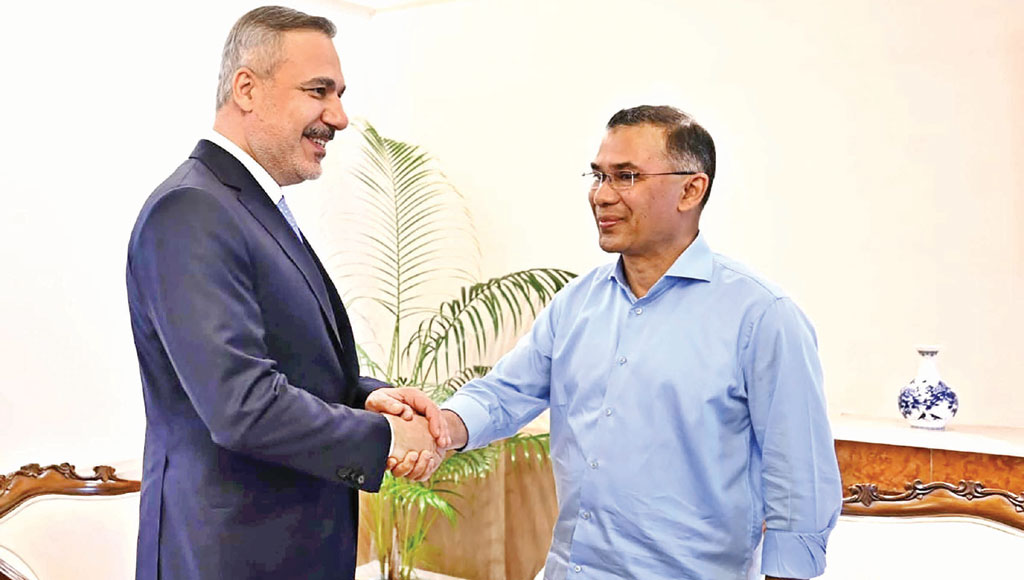
Bangladesh-Turkey relations appear to be entering a new phase. During Turkish Foreign Minister Hakan Fidan’s recent visit to Dhaka, the two countries announced several new institutional mechanisms, including an annual “2+2 Dialogue” involving the foreign and defense ministers of both countries, an upgrade of bilateral consultations to the foreign minister level, and the establishment of a joint advisory committee to strengthen political, economic, and strategic cooperation. Supporters view these developments as a significant step toward a long-term strategic partnership. Yet, as with any major diplomatic shift, important questions deserve attention. Is Bangladesh gaining a valuable new partner, or is it moving toward a relationship that could create new dependencies and strategic complications?
Bangladesh’s foreign policy has traditionally been guided by balance and diversification. Rather than aligning too closely with any single power, Dhaka has sought constructive relations with a wide range of countries. Expanding ties with Turkey can fit within that approach. However, when cooperation increasingly involves defense, security, and strategic affairs, policymakers must carefully evaluate both opportunities and risks. Diplomatic enthusiasm should not overshadow a clear assessment of national interests. While Turkey presents itself as a rising regional power seeking deeper engagement in Asia, Bangladesh must ask what Ankara’s long-term objectives are and whether they fully align with Dhaka’s priorities.
Is Turkey’s Interest Driven by Bangladesh or by Its Own Ambitions?
Turkey’s “Asia Anew” initiative, launched in 2019, is designed to strengthen Ankara’s political, economic, and strategic influence across Asia. Within this framework, Bangladesh has emerged as an attractive partner because of its rapid economic growth, large consumer market, and strategic location in the Bay of Bengal region.
While Turkish officials have described Bangladesh as one of South Asia’s emerging stars, it is important to recognize that international relations are driven primarily by national interests rather than goodwill. Turkey sees opportunities in Bangladesh’s expanding economy and its growing regional importance. From Ankara’s perspective, stronger ties with Dhaka can help advance Turkish economic interests, increase its diplomatic footprint in South Asia, and create new markets for Turkish industries.
This does not mean that cooperation is undesirable. Rather, it highlights the need for Bangladesh to approach the relationship with realism. Any strategic partnership must be judged not by diplomatic rhetoric but by tangible benefits. Bangladesh should ensure that cooperation remains genuinely reciprocal and that its national priorities are not overshadowed by Turkey’s broader geopolitical ambitions.
Defense Cooperation: Opportunity or Dependence?
The most significant aspect of the new relationship is the decision to establish an annual “2+2 Dialogue.” Such frameworks are generally reserved for countries that seek deeper security and defense cooperation. Turkey currently maintains similar arrangements with major partners such as the United States, Japan, India, and the Netherlands.
For Turkey, expanding defense cooperation is consistent with its broader effort to promote its growing defense industry. Turkish drones, armored vehicles, and military technologies have gained international attention in recent years, creating new export opportunities for Ankara.
For Bangladesh, however, the key question is whether defense cooperation will contribute to long-term national capabilities or simply increase dependence on foreign suppliers. Meaningful cooperation should include technology transfer, training, industrial collaboration, and capacity building. If the relationship is limited to purchasing military equipment, its strategic value may be far more limited than current diplomatic narratives suggest.
Bangladesh should therefore evaluate defense partnerships through the lens of national self-reliance and institutional development rather than short-term procurement considerations. Strategic cooperation should strengthen domestic capabilities rather than create new vulnerabilities.
Strategic Partnership Requires an Economic Foundation
Although political and security cooperation is receiving considerable attention, the economic relationship between the two countries remains relatively modest. Bilateral trade currently stands at approximately $1.3 billion, and both governments have expressed interest in increasing it to $2 billion. Yet declarations alone do not guarantee results.
The real measure of success will be whether the relationship generates investment, creates jobs, transfers technology, and supports industrial development. Bangladesh should focus on securing concrete economic outcomes in sectors such as infrastructure, logistics, manufacturing, renewable energy, education, and innovation. Without substantial economic gains, the language of strategic partnership risks becoming largely symbolic.
History shows that durable strategic relationships are built on strong economic foundations. Political declarations may attract headlines, but sustained cooperation requires mutual commercial interests and measurable benefits for both societies. Bangladesh should therefore prioritize economic substance over diplomatic symbolism.
Turkey undoubtedly offers opportunities for Bangladesh. Its growing economy, expanding defense industry, and strategic location make it an important international actor. Yet opportunities should not be confused with guarantees. Bangladesh must approach the emerging partnership with confidence, caution, and a clear understanding of its own interests. The question is not whether closer ties with Turkey are desirable, but whether Bangladesh can shape those ties in a way that advances its long-term national goals. In international politics, there are no permanent friends—only permanent interests. That principle should remain at the center of Bangladesh’s engagement with Turkey.